Pharmacology: Pharmacodynamics: Perindopril: Mechanism of action: Perindopril is an inhibitor of the enzyme that converts angiotensin I into angiotensin II (Angiotensin Converting Enzyme ACE). The converting enzyme, or kinase, is an exopeptidase that allows conversion of angiotensin I into the vasoconstrictor angiotensin II as well as causing the degradation of the vasodilator bradykinin into an inactive heptapeptide. Inhibition of ACE results in a reduction of angiotensin II in the plasma, which leads to increased plasma renin activity (by inhibition of the negative feedback of renin release) and reduced secretion of aldosterone. Since ACE inactivates bradykinin, inhibition of ACE also results in an increased activity of circulating and local kallikrein-kinin systems (and thus also activation of the prostaglandin system). It is possible that this mechanism contributes to the blood pressure-lowering action of ACE inhibitors and is partially responsible for certain of their side effects (e.g. cough).
Perindopril acts through its active metabolite, perindoprilat. The other metabolites show no inhibition of ACE activity in vitro.
Clinical efficacy and safety: Hypertension: Perindopril is active in all grades of hypertension: mild, moderate, severe; a reduction in systolic and diastolic blood pressures in both supine and standing positions is observed.
Perindopril reduces peripheral vascular resistance, leading to blood pressure reduction. As a consequence, peripheral blood flow increases, with no effect on heart rate.
Renal blood flow increases as a rule, while the glomerular filtration rate (GFR) is usually unchanged.
The antihypertensive activity is maximal between 4 and 6 hours after a single dose and is sustained for at least 24 hours: trough effects are about 87-100 % of peak effects.
The decrease in blood pressure occurs rapidly. In responding patients, normalisation is achieved within a month and persists without the occurrence of tachyphylaxis.
Discontinuation of treatment does not lead to a rebound effect.
Perindopril reduces left ventricular hypertrophy.
In man, perindopril has been confirmed to demonstrate vasodilatory properties. It improves large artery elasticity and decreases the media:lumen ratio of small arteries.
Stable coronary artery disease: The EUROPA study was a multicentre, international, randomised, double-blind, placebo-controlled clinical trial lasting 4 years.
Twelve thousand two hundred and eighteen (12218) patients aged over 18 were randomised to 8 mg perindopril tert-butylamine (equivalent to 10 mg perindopril arginine) (n=6110) or placebo (n=6108).
The trial population had evidence of coronary artery disease with no evidence of clinical signs of heart failure. Overall, 90% of the patients had a previous myocardial infarction and/or a previous coronary revascularisation. Most of the patients received the study medication on top of conventional therapy including platelet inhibitors, lipid lowering agents and beta-blockers.
The main efficacy criterion was the composite of cardiovascular mortality, non fatal myocardial infarction and/or cardiac arrest with successful resuscitation. The treatment with 8 mg perindopril tert-butylamine (equivalent to 10 mg perindopril arginine) once daily resulted in a significant absolute reduction in the primary endpoint of 1.9% (relative risk reduction of 20%, 95%CI [9.4; 28.6] – p<0.001).
In patients with a history of myocardial infarction and/or revascularisation, an absolute reduction of 2.2% corresponding to a RRR of 22.4% (95%CI [12.0; 31.6] – p<0.001) in the primary endpoint was observed by comparison to placebo.
Dual blockade of the renin-angiotensin-aldosterone system (RAAS) clinical trial data: Two large randomised, controlled trials (ONTARGET (ONgoing Telmisartan Alone and in combination with Ramipril Global Endpoint Trial) and VA NEPHRON-D (The Veterans Affairs Nephropathy in Diabetes)) have examined the use of combination of an ACE-inhibitor with an angiotensin II receptor blocker.
ONTARGET was a study conducted in patients with a history of cardiovascular or cerebrovascular disease, or type 2 diabetes mellitus accompanied by evidence of end-organ damage. VA NEPHRON-D was a study in patients with type 2 diabetes mellitus and diabetic nephropathy.
These studies have shown no significant beneficial effect on renal and/or cardiovascular outcomes and mortality, while an increased risk of hyperkalaemia, acute kidney injury and/or hypotension as compared to monotherapy was observed.
Given their similar pharmacodynamic properties, these results are also relevant for other ACE-inhibitors and angiotensin II receptor blockers.
ACE-inhibitors and angiotensin II receptor blockers should therefore not be used concomitantly in patients with diabetic nephropathy.
ALTITUDE (Aliskiren Trial in Type 2 Diabetes Using Cardiovascular and Renal Disease Endpoints) was a study designed to test the benefit of adding aliskiren to a standard therapy of an ACE-inhibitor or an angiotensin II receptor blocker in patients with type 2 diabetes mellitus and chronic kidney disease, cardiovascular disease, or both. The study was terminated early because of an increased risk of adverse outcomes. Cardiovascular death and stroke were both numerically more frequent in the aliskiren group than in the placebo group and adverse events and serious adverse events of interest (hyperkalaemia, hypotension and renal dysfunction) were more frequently reported in the aliskiren group than in the placebo group.
Amlodipine: Mechanism of action: Amlodipine is a calcium ion influx inhibitor of the dihydropyridine group (slow channel blocker or calcium ion antagonist) and inhibits the transmembrane influx of calcium ions into cardiac and vascular smooth muscle.
The mechanism of the antihypertensive action of amlodipine is due to a direct relaxant effect on vascular smooth muscle. The precise mechanism by which amlodipine relieves angina has not been fully determined but amlodipine reduces total ischaemic burden by the following two actions: Amlodipine dilates peripheral arterioles and thus, reduces the total peripheral resistance (afterload) against which the heart works. Since the heart rate remains stable, this unloading of the heart reduces myocardial energy consumption and oxygen requirements.
The mechanism of action of amlodipine also probably involves dilatation of the main coronary arteries and coronary arterioles, both in normal and ischaemic regions. This dilatation increases myocardial oxygen delivery in patients with coronary artery spasm (Prinzmetal’s or variant angina).
Clinical efficacy and safety: In patients with hypertension, once daily dosing provides clinically significant reductions of blood pressure in both the supine and standing positions throughout the 24 hour interval. Due to the slow onset of action, acute hypotension is not a feature of amlodipine administration.
In patients with angina, once daily administration of amlodipine increases total exercise time, time to angina onset, and time to 1mm ST segment depression, and decreases both angina attack frequency and glyceryl trinitrate tablet consumption.
Amlodipine has not been associated with any adverse metabolic effects or changes in plasma lipids and is suitable for use in patients with asthma, diabetes, and gout.
Coronary artery disease (CAD): The effectiveness of amlodipine in preventing clinical events in patients with coronary artery disease (CAD) has been evaluated in an independent, multi-center, randomized, double-blind, placebo-controlled study of 1997 patients; Comparison of Amlodipine vs. Enalapril to Limit Occurrences of Thrombosis (CAMELOT).
Of these patients, 663 were treated with amlodipine 5-10 mg, 673 patients were treated with enalapril 10-20 mg, and 655 patients were treated with placebo, in addition to standard care of statins, beta-blockers, diuretics and aspirin, for 2 years. The key efficacy results are presented in Table 1. The results indicate that amlodipine treatment was associated with fewer hospitalizations for angina and revascularization procedures in patients with CAD.


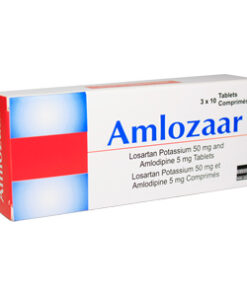
AMLOZAAR 50MG TABS 30S 


Reviews
There are no reviews yet.